

Adding Another Load Of Gravel Will Not Fix That Drive
How many loads of gravel does a 700-foot drive need before it quits rutting every spring? Around Rogersville, plenty of wedding barn owners have run that experiment for six or seven seasons without ever getting an answer. The rock goes down in April and looks sharp for the first three weekends of the season. By the second heavy rain the same ruts are back in the same places, because the problem was never the amount of rock sitting on top. It was the base underneath, and that is the whole reason civil contractors Rogersville MO talk about layer depth and drainage before they talk about how many loads to order. A drive built once with graded, correctly sized aggregate sheds water, and a drive fed loose gravel twice a year traps it.
More Gravel Is Not A Deeper Base
Spread new rock across a soft, rutted surface and it does not turn into base. Base is compacted material in graded layers, each size locking into the one below it under a roller. What we see most often on a venue drive is four inches of round river gravel sitting on clay nobody ever shaped, so every tire pushes stone sideways into the low spots. The stone migrates. The clay stays soft, and water pools exactly where it pooled last year. Dig at the shoulder of one of those drives and last spring’s gravel is usually still down there, six inches deep, doing no work at all.
A venue owner north of town added it up last winter. Four gravel deliveries across three seasons, roughly $2,600 each, and she still had to rope off half the parking field the morning of an October wedding. Nobody had ever cut a ditch along either side of that drive.
Sized Layers Do Work Loose Rock Cannot
A drive that survives 120 cars on a wet Saturday is three or four distinct layers, not one. The bottom course is larger crushed stone, angular enough that the fractured faces knit together when compacted, and above it goes a smaller graded course that fills the voids and locks the mat in place. Round river gravel cannot do that job, because smooth faces slide apart under load no matter how thick you pile them on. Sizing is the part that gets skipped (nobody photographs a base course, so nobody misses it) and it is the part that decides whether the drive lasts a decade or a season.
The money is what usually settles the argument. A March 2026 breakdown of replenishment costs for gravel lots on rural properties and event venues puts each application at $1,500 to $4,000, and notes that high-traffic surfaces need one every one to two years. Spread across a decade, that is a subscription to a problem rather than a repair.
Price The Drive Once Instead Of Every Spring
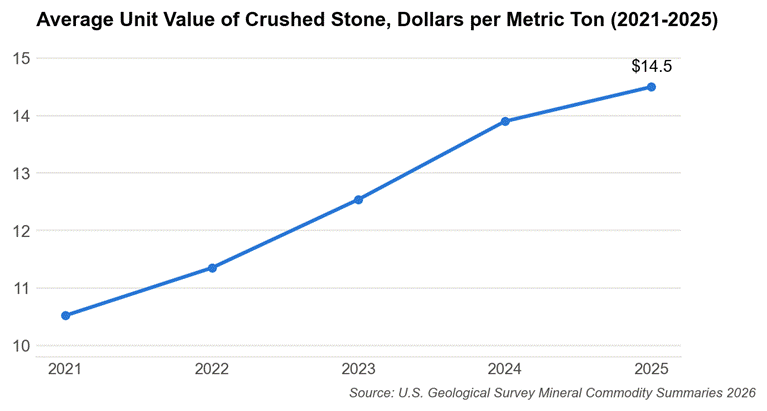
Run the arithmetic on the actual drive. Seven hundred feet at 14 feet wide is 9,800 square feet, and six inches of compacted base across that works out to about 182 cubic yards, or roughly 255 tons at 1.4 tons per yard. Say the crushed material runs $14 per ton produced on site, which puts the rock at $3,570, and add $4,200 for shaping, ditching and roller time. The build comes to $7,770 all in. Ten years of the other habit, at $2,600 a delivery every eighteen months, lands nearer $17,000 and leaves the same soft clay sitting under all of it.
Waiting does not make the material cheaper, either. Crushed stone has climbed in average value per ton for several years running, so the load postponed until next spring is the load that costs more. Producing it on the property is the one lever that genuinely moves the total, since hauling is often a bigger share of the bill than the rock itself.
None of this takes a specialist to evaluate. Walk the drive after the next hard rain and mark where water is standing, because those spots are where the base failed and no amount of surface rock will change them. A conversation with civil contractors Rogersville MO venue owners already work with should cover layer depths, where the ditch line goes, and a price for building the thing once. That quote will look expensive next to another gravel delivery, and it is still the cheaper of the two.